



So here’s my final post of this three-part series about the Vatican Necropolis under Saint Peter’s Basilica and the Tomb of Saint Peter.
In the first article we covered some generalities and the historical background for Saint Peter’s Basilica.
In the second article we went one by one through the mausoleums in the Vatican Necropolis tour, explaining each major highlight.
Today we finally reach St Peter’s Tomb!
Who was St Peter?
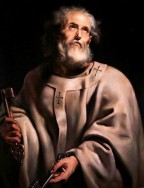
Image: aquinasandmore.com
Peter was one of Twelve Apostles who accompanied Jesus.
After Jesus’ death, Peter led the founding the Christian church and became the first pope.
30 years after Jesus’ death Peter was killed during the persecution of Christians by emperor Nero (as I discussed in the first article).
What we saw last time
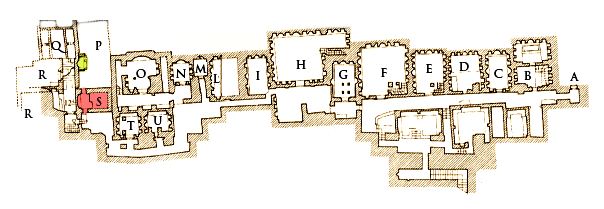
Here’s an elevation view of the mausoleums we visited in the last article. We started from right to left of this diagram (east to west) going up the slope of the Vatican Hill.

Photo: Father José Antonio Iñiguez.
You also need to understand the following drawing:
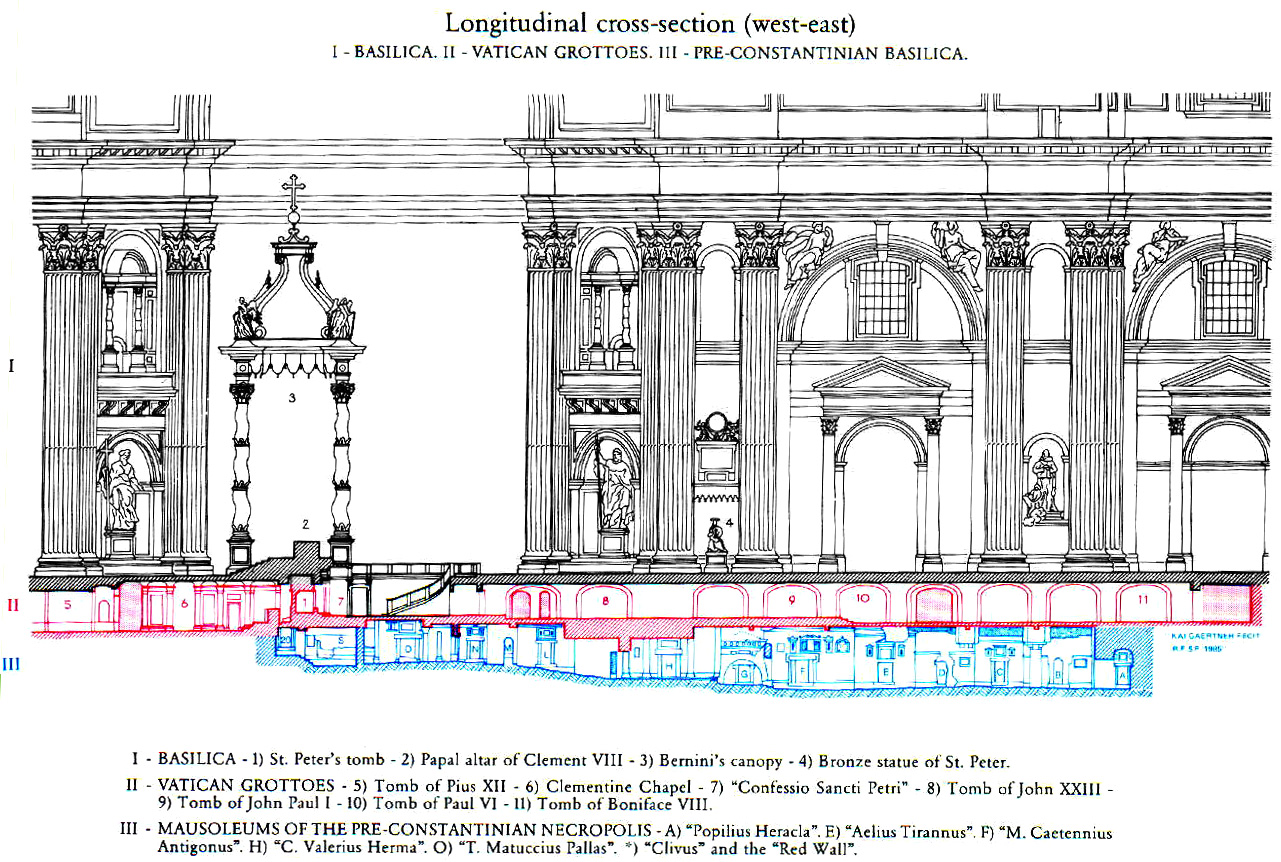
Three levels of St Peter’s Basilica. Illustrationn by Fabbrica of Saint Peter’s.
Click to enlarge.
Saint Peter’s Basilica has three levels.
Level 1: The present Basilica in black.
Level 2: The Papal Grottoes in magenta.
Level 3: The Vatican Necropolis in blue.
The floorplan we used in the second article is the blue portion of this cross-section drawing.
The drawing in the previous paragraph is also the blue portion. Can you see it?
How did the tomb of Saint Peter come to be?
Watch this 4 minute video about how the Tomb of St Peter went from a simple burial on the ground, to a revered shrine just before emperor Constantine I decided to build his huge basilica around it.
It’s very important that you watch this video before moving on, because it explains what we will be seeing and the terminology.
If the video is too small for you, you can watch it here in YouTube.
Let’s resume our tour
I will be using different views of the same place to explain what we are actually seeing.
Last time we were in Mausoleum S and I’d told it was mostly filled by the foundations for Bernini’s Baldaquino
At this point in the tour you’re in a corridor outside of Mausoleum S on its south side, not actually in it:
 Here’s what you see:

Composite view of the corridor next to Mausoleum S from the 3D virtual tour of the Vatican Necropolis at www.vatican.va
Here’s a closer look:
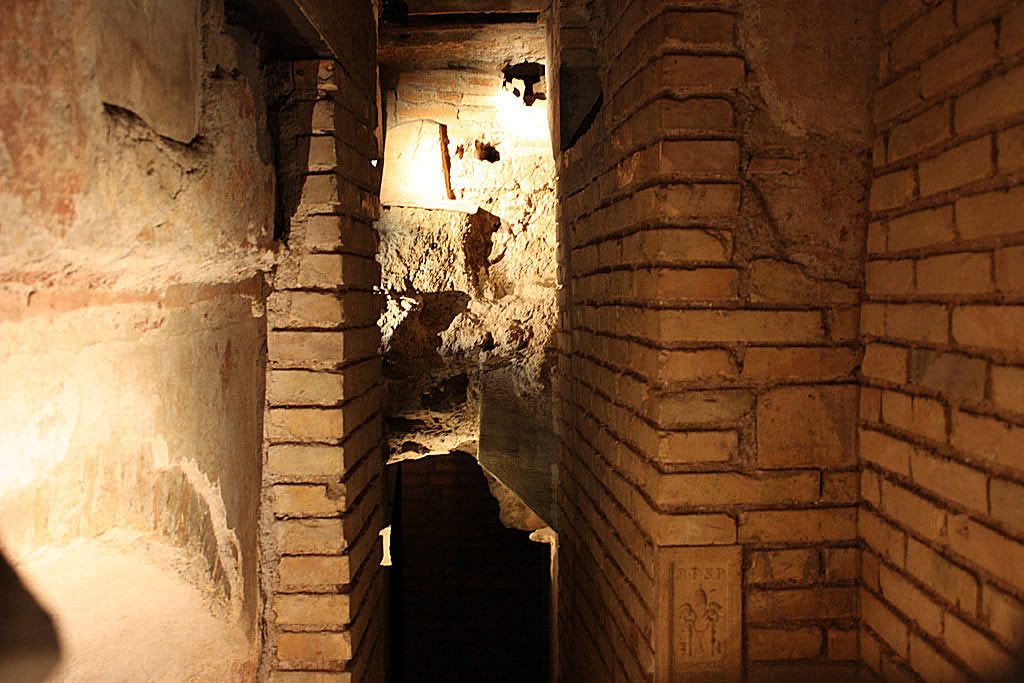
Remains of original Tomb of St Peter. Photo: Blanca & Ian’s Travels, members.rennlist.com/imcarthur/roma.htm
You are seeing the underground tomb as it looks today, from the south side. This area is under the Trophy of Gaius.
Here’s another view:
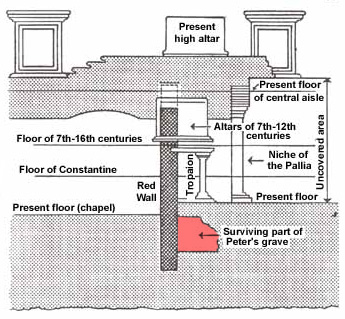
Side view of the original Tomb of St Peter.
Photo: saintpetersbasilica.org
Then you go through the door on your left and encounter the Clivus!
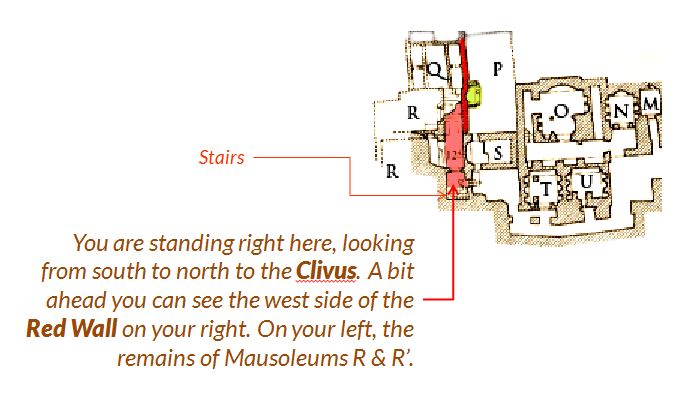 This is what you’ll see:

Composite view of the Clivus (Red Wall on the right) from the 3D virtual tour of the Vatican Necropolis at www.vatican.va
Here’s a reconstruction drawing of the Clivus:
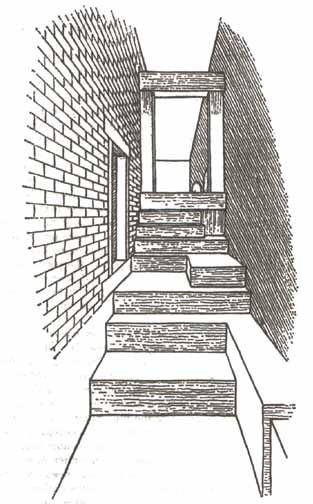
Clivus. Photo: saintpetersbasilica.org
Going upstairs
Next, you go up a flight of stairs. You are now on the second level, the Papal Grottoes level.
 Number 20 is the Clivus, see Mausoleum S on its right? Where we are now is not visible because we’re on the south side just above the Clivus, just outside of the Clementine Chapel (number 6) which I’ve highlighted in red here.
We need a floorplan of the second level, the Papal Grottoes level:
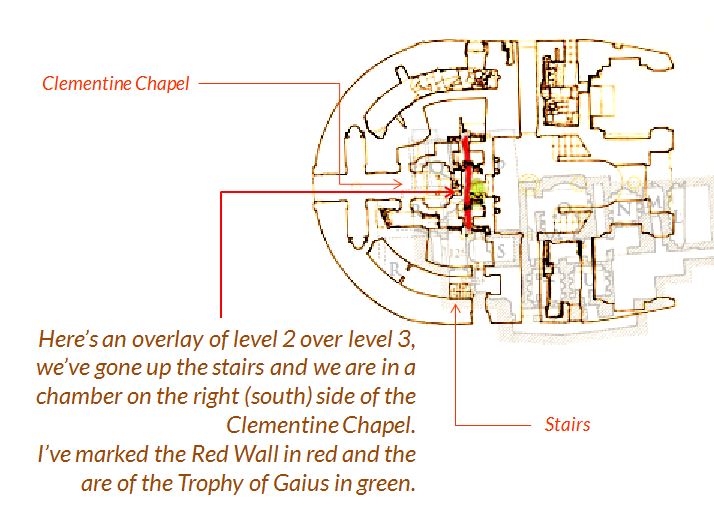 But before going any further, let’s see another little bit of history…
The Papal Altars
In the last part of the video above, we saw that Gaius Trophy was protected by two adjacent walls perpendicular to the Red Wall, walls s and g, being g the thickest.
In this model we can see wall g on the right side of the Trophy. The transparent structures above represent the bases of Bernini’s Baldaquino.

Photo: Fabbrica of Saint Peter
Constantine encased the Trophy of Gaius in a marble enclosure to protect it, discarding the top part of the monument.
The marble box had porphyry vertical decorations, with white and blue marble as the main body, like we see in this model:
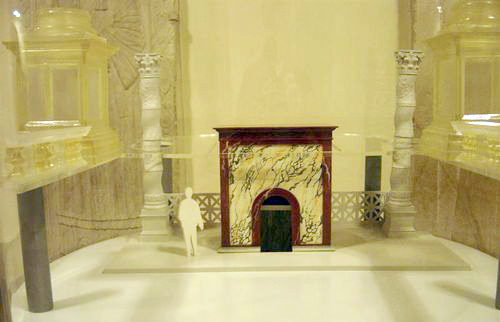
Model of the marble box of Constantine for the Tomb of St Peter.
Photo: mcsmith.blogs.com

Model of the marble box (back) of Constantine for the Tomb of St Peter. Photo: mcsmith.blogs.com
This monument from Constantine was covered by its own canopy called the Memoria.
After Constantine, three different Popes made changes to the altar, the first being Gregory I (590–604) who wanted to perform mass on top of Constantine’s monument and the tomb itself and for that, he raised the floor.
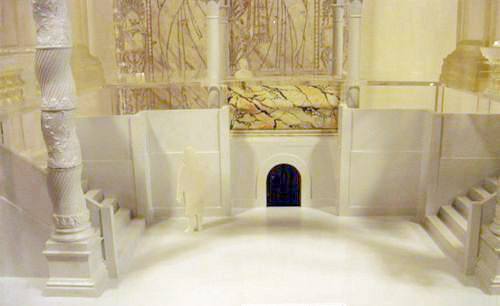
Model of Gregory I’s altar on top of the Tomb of St Peter.
Photo: mcsmith.blogs.com
He also made it possible to visit Saint Peter’s tomb from behind and so he made a small altar behind it.
Later on Pope Callixtus II (1123) had another altar covering the one from Pope Gregory.
And finally Pope Clement VIII (1594) had the present altar built on top of the others.
Here’s an image from the Virtual 360° tour of the Vatican Necropolis that shows us the different altars and an excavation image that shows us Gregory’s small altar still in place on what is now the Clementine Chapel.
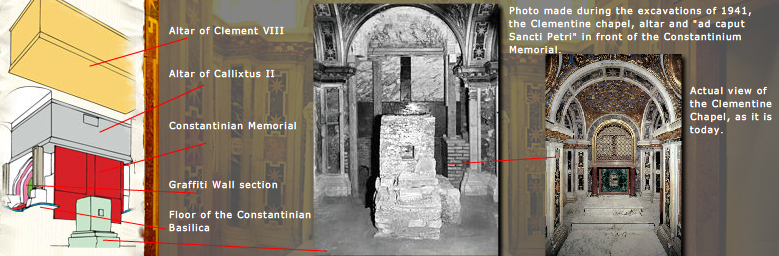
Papal Altars Tomb of St Peter. Photo: vatican.va Click to enlarge
Let’s go back to the tour
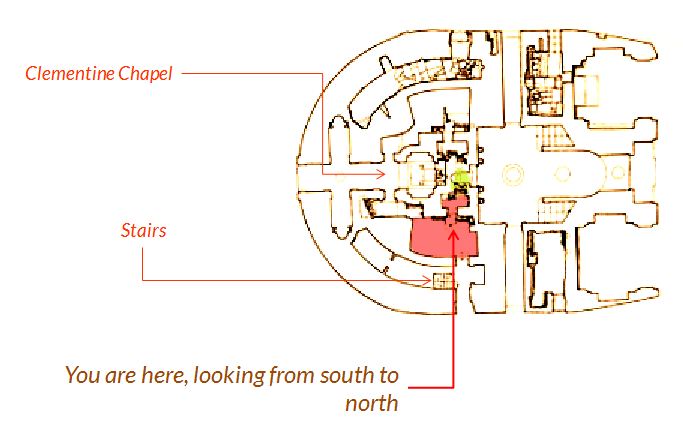 And you see:
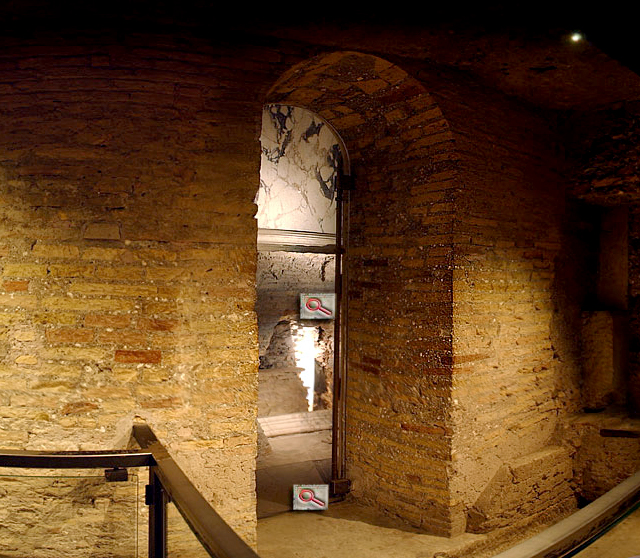
Composite view of the south side of the Trophy from the Virtual 360° tour of the Vatican Necropolis
Here is the same image, with a montage of the Trophy as it’s positioned from this point of view. Can you see the small marble column? That’s the left column of the Trophy of Gaius.
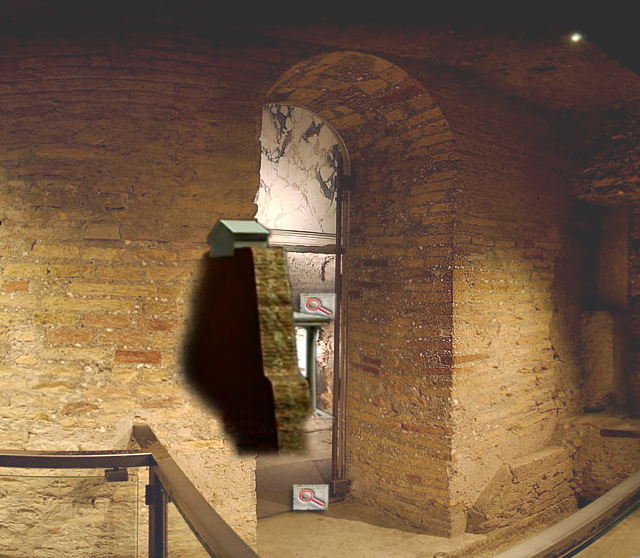
Composite view of the south side of the Trophy with montage with image from the Rai video Secrets of a Basilica – part 2 – (the grave)and the Virtual 360° tour of the Vatican Necropolis
The marble portion on top of it is part of Constantine’s Memoria, the marble box in which the Trophy was encased. Here’s another view:
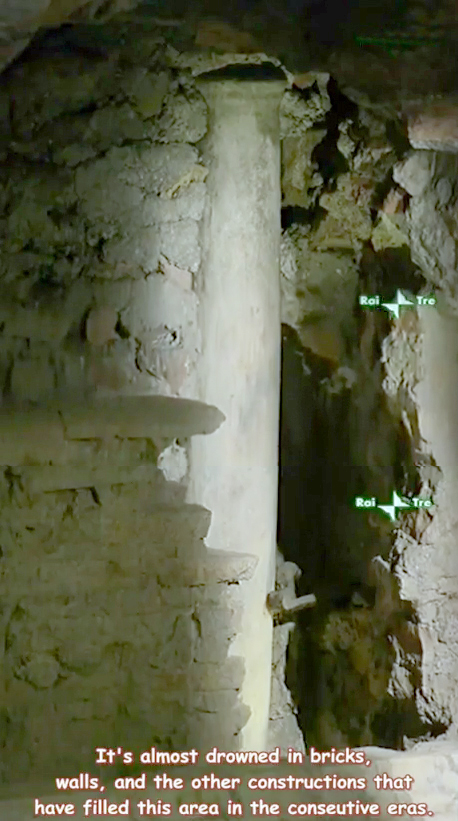
Composite image of the south column of the Trophy fom Rai Video Secrets of a Basilica. – part 2 – (the grave).
Next you step into the Clementine Chapel
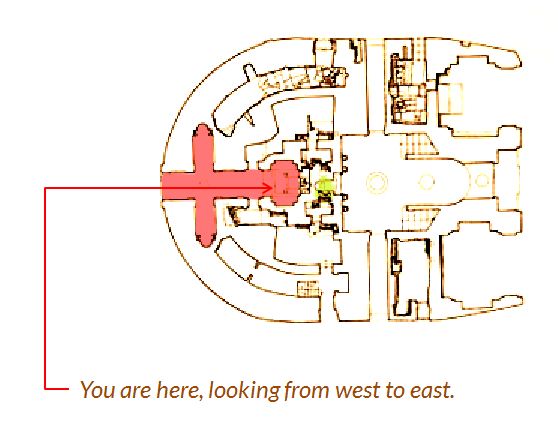 This is what you’ll see:
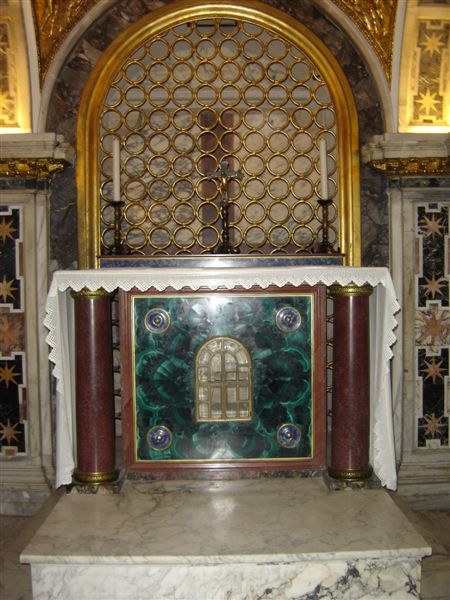
Photo: mcsmith.blogs.com
See what’s behind the circles lattice? It’s the back of Constantine’s Memoria (which has been reconstructed) with its central vertical porphyry stripe.
Here’s another look:
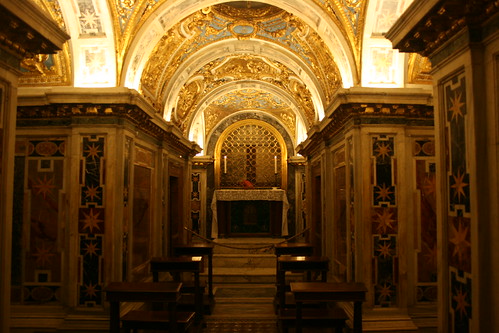
Clementine Chapel. Photo: Catholic Eye Candy cathcandy.wordpress.com
The bones of Saint Peter
Next you’ll be asked to go across the Chapel through another door on the west side:
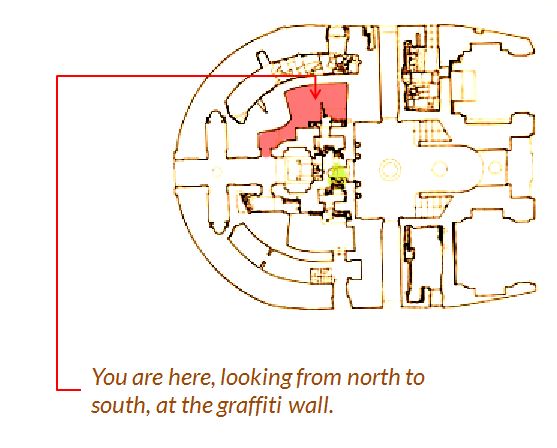 Remember wall g? Here’s a rotation of the model:
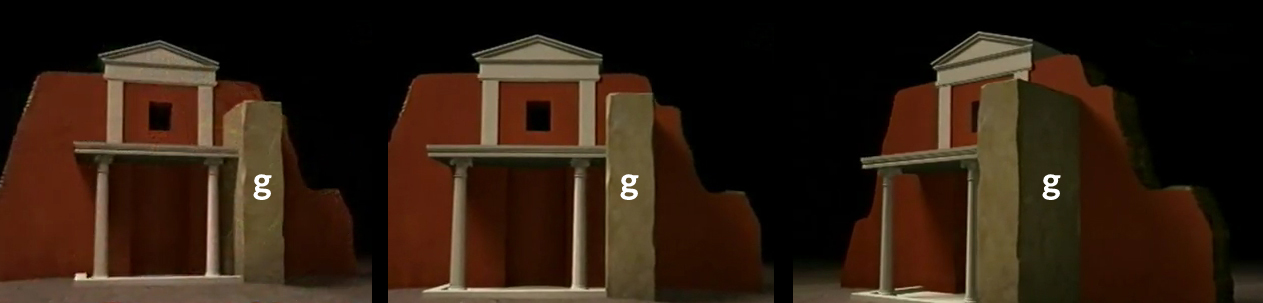
Rotated model of Gaiu Trophy, Tomb of St Peter. Composite picture from Rai Video Secrets of a Basilica. – part 2 – (the grave)
What you are looking at now is wall g, the graffiti wall, which is named after all the graffiti that people throughout the centuries carved on its surface to let others know that they were there.
Here’s what you see:
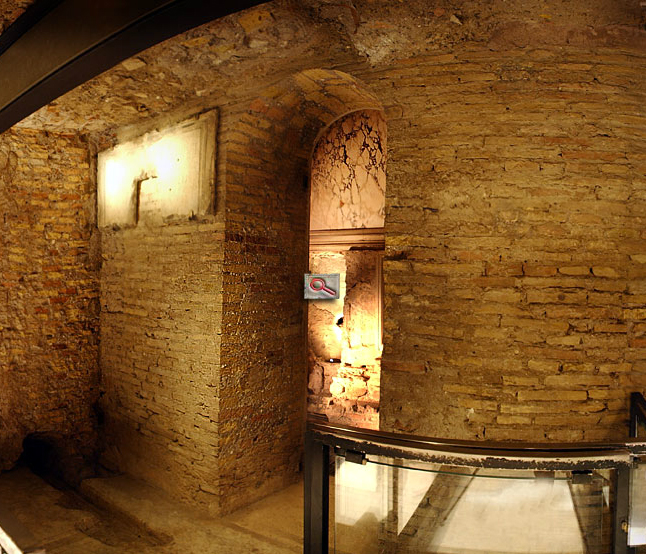
North side wall g, Graffiti Wall, Tomb of St Peter. Composite from Virtual 360° tour of the Vatican Necropolis
Here’s another view (see the niche with the bones in the middle left of the image?):
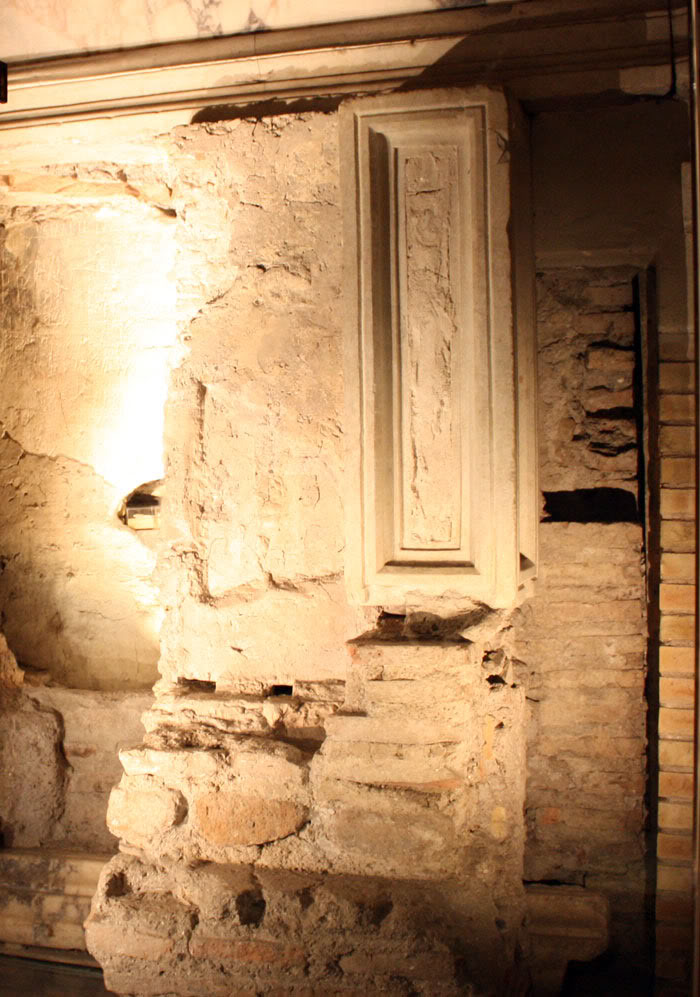
St Peter’s bones center left in glass container.
Photo: Blanca & Ian’s Travels
members.rennlist.com/imcarthur/roma.htm
But there’s more… At the time of Constantine a niche was carved inside wall g and some bones were preserved there in royal purple and gold fabric wrappings.
They remained inside the niche until the excavations in 1941 when they were taken to a nearby location up to 1953.
Then Professor Margherita Guarducci had the bones examined. The studies revealed that they belonged to a robust man, approximately 60 to 70 years of age.
Earth incrusted in the bones confirmed that they were previously buried in the ground.
These facts and the expensive wrappings are another indication that these are likely to be the bones of Saint Peter.
In 1968 Pope Paul VI announced that the bones of Saint Peter had been discovered.
The bones were placed in 19 plexiglass containers, ten of which are inside the niche in wall g, as you can see in the image above. Here’s a closer look:
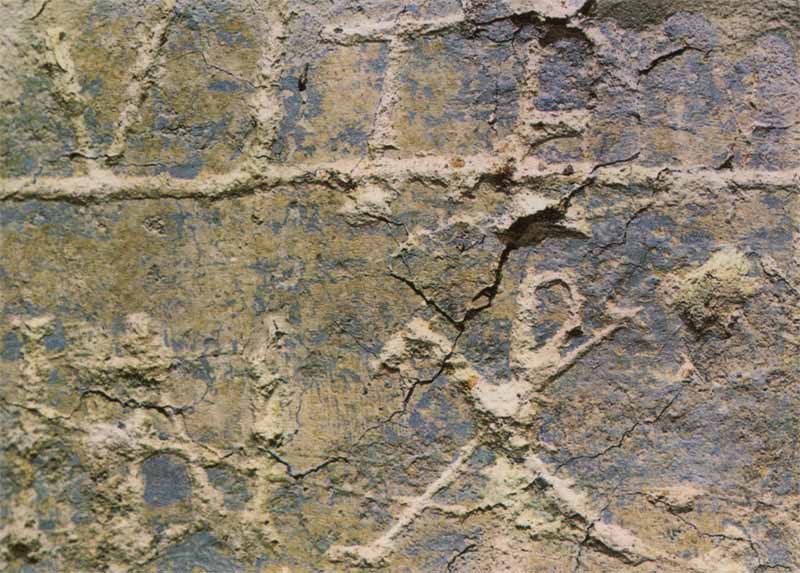
Detail of the Graffiti Wall with the Chi-Ro. Photo: vatican.va
And here’s a couple more views of the graffiti wall g:
Photo: Virtual 360° tour of the Vatican Necropolis
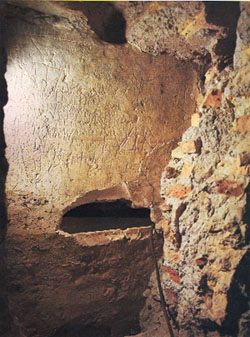
Photo: josemariaescriva.info
Here’s a view of the niche in wall g in a model:
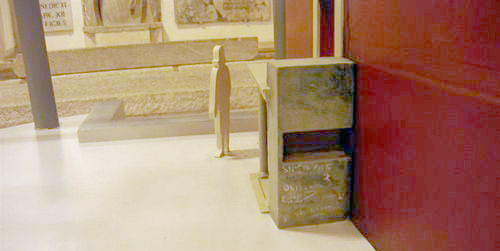
Model of the niche in the graffiti wall g on the Tomb of St Peter.
Photo: mcsmith.blogs.com
Another indication that archaeologists believe points to this being the real tomb of the Apostle Peter is an inscription in a tiny piece of stone that fell from the Red Wall, that is believed to have said “Petros eni” which means “Peter is here”.
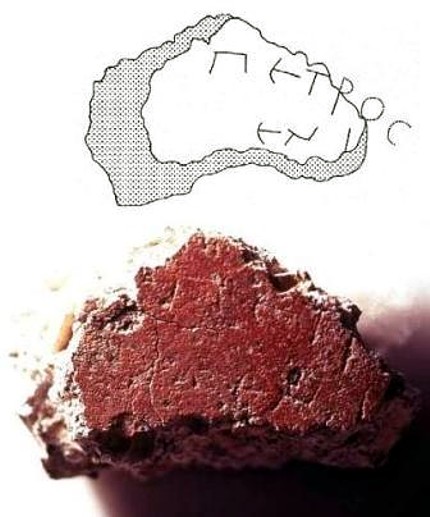
Photo: rsanzcarrera2.wordpress.com
Once you’ve seen the graffiti wall and the bones, you’ll go back to the Clementine Chapel, and this is the tricky part:
If you’ve done your homework beforehand you’ll recognize that behind the altar inside the Clementine Chapel is actually Gaius Trophy partially covered by the monument of Constantine I.
I appreciated that our guide was pretty honest about the certainty with which the church affirms that these are Saint Peter’s bones.
She never said they were. She said, archaeological and circumstantial evidence point to this fact and Christians choose to believe that they are real.
The Confessio and the Niche of the Pallia
Back inside the Clementine Chapel you’ll exit from the back through an iron gate. The guide will close the gate behind you and you can’t go back.
Then you will be escorted towards the Grottoes and you’ll pass in front of the Confessio on the level of Constantine’s Basilica.
Tthis is what you see through glass doors:
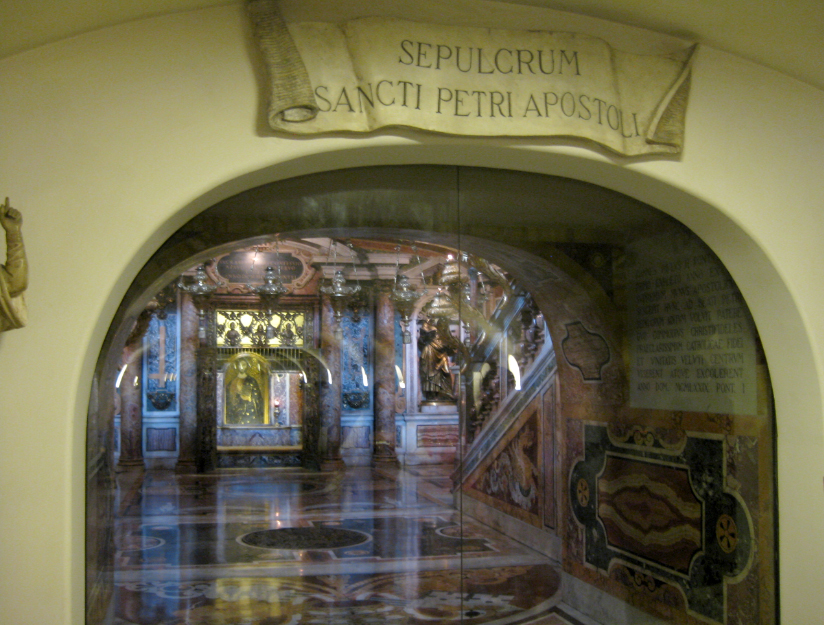
Here’s the Confessio seen from the main level of Saint Peter’s Basilica:

Photo: Franco Cossimo Panini
People are not allowed access to the Confessio. The small doors on the front are closed. Notice the columns of Bernini’s Baldaquino on the upper part of the picture.
Here’s a closer view from Maxwell School of Syracuse University.

Close up of the Confessio at Saint Peter’s Basilica.
Photo: Maxwell College of Syracuse University.
The center piece, with the mosaic is the Niche of the Pallia, “Pallia” being the white stoles priests wear around their necks.
Notice how the niche is a bit off-center?
If you look closely to the two following diagrams (though dimensions do not match between them), you’ll see the Niche of the Pallia is actually part of Gaius Trophy.

Front and side diagrams of the Niche of the Pallia.
Photo: saintpetersbasilica.org Click to enlarge.
That’s right, Gaius Trophy is right behind the mosaic veneer and marble covering.
When you look down to the Confessio from the Basilica, you are actually seeing the ancient monument that stood on top of the Apostle’s grave.
Here’s a final ten minute video explaining this in a very easy way:
If you’ve visited the Vatican Necropolis, share your experience!
And if this material was in any way helpful for you and your next cultural travel to the Vatican, please leave me a comment!
Resources:
- Two videos from Father José Antonio Iñíguez, a Spanish priest who explains everything about Saint Peter’s Tomb (in Spanish).
- Video music: J. S. Bach: Brandenburg Concerto No4-1 BWV1049 by Kevin MacLeod.
- Virtual 360° tour of the Vatican Necropolis








I was part of a church group that was privileged to tour the underground catacombs of St. Peter’s – a truly awesome experience. Our guide took us to the place where Peter was buried in a sarcophagus of stone and told us that the Hebrew inscription read “Peter lies within”. I’ve read so many contradictions since then, but I choose to believe that this is the true burial place of Peter the Apostle.
Spectacular explanation. I went through the Scavi tour several years ago, when I took the pictures, and this makes it a lot clearer. I thought I remembered seeing the boxes with bones in the recess, but glad you have photos of them to confirm.
Hello! This was a fascinating read. One thing I’m unclear on is that you claim that St. Peter’s grave was marked with a red stone. However, I haven’t been able to find any other evidence mentioning any red stone as a grave marker at all. Do you have any more specific information on the red stone? Thank you!
[…] believed to be situated on Apostle Peter’s burial ground, whether you’re religious or not it makes for an extremely interesting place to discover. […]
[…] Informações mas detalhadas sobre a Necropolis você encontra neste site aqui: Culturaltravelguide.com […]
Thanks for your explanations! I just read “The Bones of St. Peter” and was having trouble visualizing it all. Your posts really helped a lot. It’s fascinating and I’m definitely going to do the tour next time we go to Rome. After reading the book, I think there is a pretty convincing case that the bones and tomb are really St. Peter’s. Of course, there is no way to know with 100% certainty.
Yes, Patrice! It’s an incredible visit, whether you’re catholic or not. Reading the book will definitely give you an advantage to comprehend what you’re seeing, so the visit will be that much more meaningful. I hope you have an amazing time!
I hope this hasn’t been addressed already. I’m a bit confused as to the layout. Please correct me if any of my assumptions as to how things are arranged are wrong.
You say that the portion of (what is believed to be) Peter’s tomb that is viewed through Mausoleum S is *under* the Trophy of Gaius (which I take to mean that the foot of the Trophy is essentially at the “ceiling” of that room). And it’s hard to get a sense of scale from the pictures, but I imagine that the room which now houses Peter’s original tomb is at least five or six feet high, floor-to-ceiling. But, as I understand the geography of the place, the Clivus is immediately adjacent to (and on the same level as) a person looking through S toward the tomb. And the YouTube video you posted seems to imply that the Clivus was essentially at the same ground level (gave or take a couple of feet) as the ground upon which the Trophy was built. So how is the Trophy so much higher than the level of the Clivus? Did the ground level directly above Peter’s tomb rise so much that, by the time the Trophy was built, it was already several feet above the Clivus?
Hi, Greg! That’s an excellent question! You’re very insightful!
Ok, first of all, I’m not an architect, and the plans and reconstructions are not as detailed as one might like. Also, the Vatican Necropolis Virtual Tour could be a lot better and it’s quite confusing… so bearing that in mind, here’s what my understanding is:
The portion of the Clivus that is visible today (with the Red Wall to the right) would have been the portion of the wall that was underground. As Father José Antonio Iñíguez explains in his video (which I linked to in the article) the wall went underground as well, behind the tomb. This is further explained at timestamp 2:22 of this video: https://youtu.be/5oJDbnDh7iA
Now that begs the question: who would paint red a wall that would be underground? Right?
I’ve done my best to go back to the virtual tour and to check again the literature and there’s a lot that’s very confusing still. As I said in my article, when I visited the Scavi I was not fully prepared, hadn’t done my research and consequently many of the details slipped my mind afterwards. It’s my wish that I will go back again (with my articles in hand) and check bit by bit if I am right.
That’s why I’ve encouraged every person who has written here telling me they’re going on a tour of the Scavi, to come back and help me correct any mistakes I may have made.
Thank you again for your comment and if you have more light to shed on this, please do so!
Carolina,
Thank you for your response. I’m still puzzling this over in my head (and I’ve ordered a copy of the book Tim York mentioned in his comment below, which may clear the whole thing up—I can’t shake this!). I guess the thing I want to figure out is: is the floor of the Confessio Petri at the same level (give or take a foot) as the ground upon which the Trophy was built, such that a person at the niche is in the same place as a 2nd-century pilgrim? Assuming that the Clivus, when built, was not underground—which I think is a reasonable assumption—there are only two ways I can think of that allow for the present arrangement of things.
The first is that, by the time the Trophy was constructed, the ground level on that side of the Red Wall was indeed higher enough than the level of the Clivus to account for the present-day elevation difference between the Clivus and the Confessio. In this scenario, the Clivus was buried while the Vatican Hill was being levelled for the old basilica, but the Trophy has remained intact in place since then. This would imply a LOT of natural levelling of the slope on which Field P was located in the eighty years or so between burial and the building of the Trophy, but maybe the very existence of the Red Wall implies that this amound of earth-shifting was taking place and a retaining wall was thus needed.
The second is that the levelling of the Vatican Hill to construct the old basilica required that the whole complex, including the Clivus, Field P, and the surrounding tombs, be buried under a number of feet of earth and that the Trophy was removed and replaced at the new ground level directly above where it had been, and the basilica was then built around that place with everything below it being buried. That would neatly explain everything about the present arrangement and would only require that the Church not mention that the Trophy had been moved at the time the old basilica was constructed.
Hopefully that all makes sense?
Hi, Greg! Yeah, it’s a puzzling question indeed!
I think our best bet would be for you to receive the book, give it a thorough look and come back and let us know what you found out!
I think that without actually going to the Scavi and checking every detail out, it’s difficult for us to be sure of anything.
Now, as for your second option, I have not found any literature (nor did the tour guide said so) that mentions that the terrain where the actual tomb was, was moved in any way. They claim it’s the actual tomb as it were in the first century. Now, I’ve mentioned that the tour guide was (in my view) very sneaky and she wouldn’t give us all the information at the exact moment we were seeing the tomb, so…
After my research my understanding was that what is actually behind the Niche of the Pallia was the tomb itself, which is why the Pallia are placed there before they are given to bishops, because it’s such a sacred place. But I could be wrong.
It will be very interesting to see what you come up with after you get the book! Thanks so much for commenting!
Sorry to have to insist that the alleged bones of St. Peter may not be those that have been declared as such by the Vatican.
The reason is very simple: the analysis of carbon 14 have proven to be a man of about 65-70 years, but at the date of the death of Peter 62-65 AD
The apostle had to have between 80-82 years.
Bertolami Ugo
It’s ok to insist, Ugo! This is a place for all people who want to share their opinion openly.
Thanks Carolina. I added the English translation (by Google translator) for those wishing to explore this topic.
http://digilander.libero.it/nousland/The%20real%20Peter's%20Tomb.html
Greetings
Ugo
I was searching for tomb of st peter on google, then i found this. wow, i love this post. this is very interesting!
Thanks, Chun! Are you planning on visiting the Vatican Necropolis? When you get there, do come back and let us know what you thought of the tour!
I visited the Vatican in 1999, and it’s architecture and art has been a bit of an obsession of mine since then. I have read countless books and articles dealing with everything to do with the area. I think about my trip there every day, although it was made 15 years ago.
I just want to give you a big heartfelt THANK YOU. This type of information, photos, and drawings are exactly what I have been looking for these past 15 years. I am forever fascinated by this incredible place and want to learn as much as I can about it. For me, some of the most interesting aspects are what lie beneath the modern floors.
I remember making my way downstairs to the Papal Grottoes alone, and there being not another single person in sight. Being amid the Tombs of the Popes, and standing at the glass doors of the Confessio in utter silence, was an experience I will never forget, and one I wish to recreate. I could literally feel the history around me.
At the time, I was unaware of the Necropolis. I discovered information on it after the fact, and was awestruck by what had been beneath my feet without my knowledge. Since then I have made it a point to learn all I can about the different levels and time periods.
With each new bit of information I aquire, my desire to return to this place seems to double. I hope I can get back to Rome soon. Thanks again for your sharing!
-Joseph
Thank you for your wonderful comment, Joseph! As I read it I can relate to your experience. It’s definitely an incredible place to visit and inmerse yourself in history.
This series was also my attempt to embed the memories in my conscience, as one of the most impactful travel experiences I’ve ever had.
I hope you will go back soon, and I hope I will go back soon, too! But when you do, come back and let us know how it went and if the article helped you make sense of the various spaces!
Good luck!
Carolina — I have gone through the 360 degree Virtual Tour of the Necropolis a number of times after returning home from actually being there, and combed your article a number of times as well, but have not been able to fully coordinate either with the actual tour of the Necropolis I had last June 3rd or 5th. I did not make an appointment ahead of time, but went to the Scivia office with my Carmelite sister who was in a in a wheelchair and who had on previous trips by herself been allowed to go without a guide to pray near St. Peter’s grave/tomb. This time she was not allowed to go with me, a Camaldolese Benedictine monk. There was a tour group ready to begin their tour, but a woman who was with us and myself were not able to accompany this English-speaking group because there was no room for us. However, we waited not more than 30 minutes to an hour and were allowed to accompany another group which also had an English-speaking guide. The woman with me found it too warm and humid and early on had to go back, but I continued with the group.
According to my recollection, when we came to the area of the Mausoleum S, or thereabouts, on the right of us we passed a relatively wide and short Chapel — certainly not the Clementine Chapel, it seems to me, which is “long” and narrow and Cross-shaped. No mention or depiction of such a chapel can I find anywhere.
Then we made a sharp Right turn. We may have gone up a few steps in the roadway and proceeded a short distance — I would say to pass the outer wall of the chapel described in the last paragraph. Then we came upon what I would describe as the South view of the tomb of St. Peter. There was a railing barrier which no one is allowed to go under to enter the chamber which may have a glass door. The tomb is inside. Only one person at a time could go into the pathway up to the outer wall to look inside the chamber. If we divide the view into 4 equal sized vertical rectangles, 2 lower and 2 upper, I would say there was a vertical rectangular hole more or less in the lower right corner of the upper left rectangle. In this were a few of the bones believed to be of St. Peter. I saw only parts of 2. I do not recall anything being said about their being in plexiglass or glass containers. I would guess these were about at my eye level or a little above. I am 5 ft. tall.
We were shown only one location of St. Peter’s tomb. I would say this was the South side view, and my recollection is that it resembles the images in your article of this view, with changes made since those photographs were made. I certainly do not recall seeing anything resembling the Clivus with its steps.
Now one of the cross section diagrams shows an area in red which is labeled ” surviving part of Peter’s grave”. This is be below the floor level of the Necropolis. Were any bones found here?
One more puzzling thing: In the drawing you include in your article after dealing with the Clivus you show between the Clementine Chapel (which you filled in with red) and the Confessio, below the present altar and above the Necropolis, there is a white square in the middle level containing the number 1. On the schematic drawing of the 3 levels of St. Peter’s — the present basilica in black, the middle level of the papal tombs in magenta, and the Necropolis in blue — you identify with respect to the present level: “1) Tomb of St. Peter”. Are any of his bones inside this area?
You state that his bones were placed in 19 plexiglass cases, of which 10 are in the south side chamber wall which contains Peter’s tomb.
Where are the other 9? The bones publicly displayed years ago were all arm & leg bones. What about Peter’s skull, spine & rib cage, pelvis, hands & feet?
Maybe you can untangle some of if not all of these problems, if you have not already dealt with them elsewhere…
Best wishes in the Lord! and thanks for at least reading my long comment/problems/questions.
Thank you so much for your comment, Brother Gabriel! Certainly very interesting!
Visiting the Necropolis, unfortunately, has a few aspects that are not so great. For starters it’s dimly lit, humid and cramped, so you may feel a bit claustrophobic. You are also not allowed to venture in on your own; you must be part of a group and you must walk with that group the entire time, at its pace. Plus, you are not allowed to ask questions during the tour, you’re insrtructed to wait until the end of the tour. These conditions make it hard to be able to interpret this 3D space, with all its layers and chambers, especially when you are overcome with excitement, awe and emotion.
I wrote this series in an attempt to make sense of my visit, after the fact, but I am yet to go back and make absolute sure that I am 100% accurate, which is why I encourange people in my article and the comments, to come back here and let us know if the articles need to be corrected in any way.
Actually I would say your sister was very fortunate in being able to get in without a guide, but of course, it sounds like she was there for contemplation and not necessarily interested in the archaegology of the site.
Also, by the sounds of it, it would seem that different guides may use different “routes” inside the site or even different guidelines to conduct the visits as I myself was allowed to see the rests of Gaius Trophy (which is under Constantine’s monument) from both the north and the south, And I did see the graffiti wall and the small plexiglass containers. I also saw the Clivus and its steps and the Red Wall.
As for where the bones are, what I wrote in the article corresponds with my research using the book by Margherita Guarducci, The Tomb of Saint Peter (http://www.amazon.com/THE-TOMB-OF-ST-PETER/dp/B0000CKTQ8) which used to be online, but it’s not anymore. It was my understanding that some of the bones were actually inside the Niche of the Pallia, which makes it such a sacred place, where the pallia are put before being bestowed onto a priest, but don’t quote me on that, I can’t remember where I read that. My article was written two years ago and things may have changed.
I would refer to Margherita Guarducci’s book, since she was the scientist in charge of the analysis of the findings in Saint Peter’s Tomb. I hope that helps!
I wrote you already December 9, 2012. I put online a part of my dossier on the “Tomb of St. Peter.” I challenge anyone to refute my thesis.
In the Vatican they know all along that there has never been any tomb of the Apostle Peter (as you may well read)http://digilander.libero.it/nousland/index.html
This does not mean that Peter was never in Rome, or that I want to question the primacy of the Church of Rome.
I am a convinced Catholic, but the truth today may be disclosed without any damage.
Please read this my work that cost me several years of research.
Ugo Bertolami from Rome
My wife and I have just returned from two weeks in Europe. The Scavi Tour was by far the most impressive of all the tours we took during our stay. It was also the last before we had to leave, sad to say. Although, I am not Catholic nor a very religious person, I have to say that the evidence presented during the tour left me with no doubt that these are indeed the bones of Peter. There are just to many pieces that fit the puzzle; age, graffiti, the coins in the grave, and if I’m not mistaken, the cloth that still exists safe in the Vatican vaults according to our tour guide. Also the fact that there were no foot bones or fragments found suggest that this person was buried with no feet, the easiest way to get someone down from the upside down crucification would be to cut off the feet.
As I said I am not a religious person by any means and I’m sure this topic will continue to be debated about the authenticity of the bones. I would just make two points…one, the bible is not a fully historic document and shouldn’t be construed to say that if it isn’t in the bible it didn’t happen. Two, go and see for yourself and make up your own mind. The tours are limited to no more than 12. Hence make your reservations early; we booked in February for our tour June 19th.
Finally, thanks for this post. The tour only gave me a taste for more information.
Best regards,
Thank you so much for that comment, Michael! Couldn’t have said it better myself!
Things are never black and white, there are a ton of greys… and each person is entitled to their own opinion. The best option is to go and check it out for themselves!
I thought the Scavi was amazing, definitely a not-to-miss experience at the Vatican.
I first became interested in what lies beneath St. Peter’s while on vacation in Martha’s Vineyard in the late 1980’s. While there, i was perusing a used bookstore and stumbled upon the book “The Tombs of St Peter & St Paul” by Engelbert Kirschbaum and John Murray S.J.
I was completely captivated. I couldn’t put it down. Since then I’ve re-read it twice! (It can be gotten at Amazon.com and I strongly recommend it to anyone who wants to explore this subject in-depth. Though published in 1959 it remains the most exhaustive book I’ve ever read on this subject.
I was also able to visit the ‘scavi’ 3 years ago and the experience was unforgettable! It’s essential that you familiarize yourself BEFORE you visit as it can be very confusing. It’s also important when you start looking at maps and diagrams to realize that the Vatican faces WEST (not east as is traditional in Catholic Churches).
Why does the Vatican want to mislead people on something they know is not true.There is no Biblical record of Peter being in Rome. If they are not quite sure of where Apostle Peter’s grave is why not say so rather than want people believe that it is? If Saint Peter was their first Pope how could they not know where their Pope was buried? Do you tell me that maybe in the next 100 years the church would forget where Pope John Paul II was buried? After all the message that the Catholics are preaching or faith being practiced is different from that of Peter. Isn’t Peter who are asked to be crucified upside down? Was it in Rome I wonder? The one we would believe to have been a
Pope is Paul, because is was the one assigned to preach to the Gentiles(Acts22v21….Depart; for I will send thee far hence unto the Gentiles). and was in Rome writing to the churches e.g Romans, (Romans 1 verse 15 .So, as much as in me is, I am ready to preach the gospel to you that are in Rome also.) Galatians, Corinthians , Colosians. etc. Talking of Rome, I believe this was going to be the beginning of gospel of Christ in Rome, I stand to be corrected if wrong.. We don’t have the evidence of Peter being in Rome in the Bible but know that Peter was in Jerusalem (Biblically). There is a lot of uncertainty in this issue given the fact that there is no. evidence and there is contradictions between the facts in the Bible and those of the Vatican. In what. year did Peter become the first Pope and when was the church founded and would Pope Peter held Paul a prisoner in Rome when they were preaching the same gospel?. The church must have those. records. If they know the number of Popes who have been on that post and they definitely. would have that all the information. Go to the book of Revelation. in the Bible and read it carefully and you will understand the reasons behind all this misinformation.
Thank you for your comment. Let me invite you to read all the previous comments where the subject has been discussed.
Thanks Carolina for your complete explanation of the Necropolis. I was there in march and cameras & video are prohibited, for that reason your detailed work is great.
A must see tour in the Vatican, specially for Catholics!
Thank you so much for the nice comments, Claudia! I am glad the article was useful for you! What was your favorite part of the tour?
I will be in rome on may 17and have reservations for the Scavi tour – found your web site by accident! So glad I did – will let you know how how it goes! Grazie! (practicing)
Oh, cool, Marian! Yes, please do come back and let me know how it went! It will be an incredible experience, I hope my 3-part series will help you make the most of it! Good luck!
[…] as you will soon see, is part and parcel of their ancient culture of confabulation (see: http://www.culturaltravelguide.com/real-tomb-saint-peter-under-saint-peters-basilica). These dead bones are indeed authentic and were robed in purple and attended by other signs of […]
Wonderful tour. Is the cloth in which the bones were wrapped still in existence? Where can it be seen? Also, did the bones show any signs of crucifixion? How complete was the skeleton?
Hi, Luke! I have no idea if the cloth is still in existence, they don’t show it to you anywhere. It is my understanding that when we say “bones” we are referring to fragments of bones… what you can actually see are just fragments of bones in small plexiglass boxes.
But if you’d like even more depth of information, I recommend you go to http://saintpetersbasilica.org and then to http://saintpetersbasilica.org/tours.htm, where you can find all the related information.
Specifically you can go to http://saintpetersbasilica.org/Necropolis/MG/TheTombofStPeter-1.htm to read the classic book by Margherita Guarducci which deals with the excavations and ancient tradition of St. Peter’s tomb under the Vatican basilica. © 1960, Hawthorn Books. Hope that helps!
[…] fully-illustrated guide to St. Peter’s […]
[…] which may be the most interesting course I have taken in college, our professor brought us to the Vatican Necropolis, which are the excavations under St. Peters Basilica that were discovered in the 1940s when the […]
A privilege for all the Christians to visit the scene of the sacred tomb of the first pope st. peter
Privileged when visited the scenes of sacred tombs.
This was very helpful in understanding the tour. We will be going in March and hoping to see everything there. Is there usually a long line to see Saint Peters tomb and the Necropolis? There is also another tour of the Vatican which I heard was a really long wait. Where does this tour end and would it lead to a gate out to the Vatican to avoid the long wait?
I’m sorry I took so long to answer! I was away for a few days. There is no line to go into Saint Peter’s tomb and the Necropolis, because you have to book your visit at least one month in advance. More information about this under “Practicalities” in part 2 of this series (http://www.culturaltravelguide.com/roman-mausoleums-saint-peters-basilica). The tour ends at the main entrance of Saint Peter’s Basilica, so as a bonus you don’t have to get in line to enter the Basilica, you avoid the long wait! I hope this helps and do let me know how your visit went!
I toured the Scavi October 25th of this year. not as a pilgrimage, but still with a sense of reverence. I was so excited to see for myself the things your blog educated me about. My only complaint is that they should warn fat people like me how humid and warm it is kept. Oy! :-)
They do say that the tour may not be for you if you’re claustrophobic. But you’re right… it is pretty humid and confined and warm… Spaces are pretty small and it is dimly lit. Something to consider since the tour can go for an hour to an hour and a half. Thanks for your comment!
I will be visiting sept of 1213 and appreciate the info. It will make the tour that much better having read all this. As a catholic I choose to belive that St Peter rests there. Iam sure this added knowledge will only strengthen my faith. thank you for your hard work.
Thank you for your comment Cheryl! Do come back and let us know if the information was helpful or if something changed or needs to be corrected! Have an awesome trip and a fantastic 2013!
I’m sorry for the profusion of evidence taken in your article, but the truth is quite different: St. Peter was never buried in the Vatican.
The first burial took place in the cemetery Ostrianum and then his body was moved several times. Is now buried in the catacombs of Saints Marcellinus and Peter on Casilina.
The thing is for sure but it was always kept secret. Currently you are looking for the grave.
Ugo Bertolami Rome
The story was revealed on the book by Antonio Socci “I giorni della Tempesta “
Thanks so much for your comment, Ugo! Definitely interesting to see new perspectives! As with anything from ancient history, even scientists say there is a margin for error. During the actual tour at the Vatican Necropolis, tour guides don’t ever say that for sure that is the tomb of the apostle. But that some “circumstantial” evidence points to that, which I guess, if this was a crime court trial, wouldn’t hold up.
It is my understanding that there are several theories and any of them can be as true or as false as the “official” proclaimed by the Vatican. I don’t think we will ever know for sure.
The book you mention is a fiction novel, set in 2015, so I would wonder how much it is based on actual Vatican documents and how much is made up by the author. Here’s a link to the book: http://rizzoli.rcslibri.corriere.it/libro/5801_i_giorni_della_tempesta_socci.html
I’ve used Google Translate (Sorry, I don’t speak Italian, though I wish I did!) to translate the synopsis:
“The day of the storm
May 2015. In a church in Rome a man whispers in the confessional a heinous sin and shortly after he was assassinated. The victim is a priest who has stolen a secret file from the Vatican archives. What was in it so precious? They are the letters of an extraordinary twentieth-century mystic, Maria Valtorta, who in 1949, at the request of the Vatican, he pointed to a Roman catacomb as the true location of the tomb of St. Peter, denying the claim of those who are put under the Vatican Basilica. It is a matter of enormous importance: the presence and the martyrdom of the Apostle in Rome is based on the primacy of the Pope and the same hierarchy of the Catholic Church. Don Michele is unofficially in charge of investigating to see if other writings of the mystic reveal the exact location of the burial. Meanwhile, against the Church are locked in a real persecution, and while the world stands on the brink of terrible misfortunes, Pope Boniface X dies. Don Michael, with the help of some friends, he returns to Valtorta’s notebooks: they contain explosive revelations thanks to which it is perhaps possible to trace the location of the tomb of Peter, and even find his body. Thus begins a race against time before the start of the conclave and is perpetrated a coup. The development of this mission can save the Church from suicide and the world from a catastrophic self-destruction … In this exciting novel, based on real documents, Antonio Socci leads us to rediscover the extraordinary figure of Maria Valtorta and trace a common thread between the origins of Christianity and our gloomy present.”
Certainly a motivation to keep researching! Thanks again!
We participated in the tour of the necropolis today and looked at the proclaimed bones of St. Peter. My only question to those who do not believe the
Immediatley and for centuries after the time of his death, why did so many religious leaders chose to build monuments upon monuments over this grave site and not in Jerusalem instead?
I wouldn’t know an accurate and true answer to that. Certainly things are never black and white and there are always a myriad of factors that come into play in the history of a place, many people influencing these decisions. Going to the necropolis is to some people a fantastic archaeological view of what a Roman first century cemetery would have been, and for others, a personal act of catholic faith. Whichever you are, you are free to choose your own interpretation. Scientists are always trying to reveal the secrets of the past, but we all must recognize that these are not exact sciences, that the passing of time and what’s left for us to see and analyze may present a fragmented picture.
I went to Rome,because i loved the history about the Romans.
It was strange when we were getting off the bus i immediately made my way to the Colosseum,and ignored St Peter`s. St Theresa did the same,she went to the Colosseum first. I wasn`t bothered about St Peter`s. I believe the guy up above is right when he says St Peter`s Tomb was found in Jerusalem with “Simon Bar Jonah” written on the side of the Ossuary in Aramaic. He stayed in Jerusalem until he was martyred. No where in the bible does it say St Peter was in Rome. St Paul would have told you so,if he was,all Paul said that Mark was with him. St Peter was supposed to be crucified upside down,again there is not one witness to bear this out in the Bible. The so called bones of St Peter cannot be seen fully by the public.
Thank you for your comment. As I’ve said before, it’s a matter of each person’s faith… in my opinion it doesn’t matter whether it’s true or not. In the end, the site is a magnificent example of first century Roman burials which is unbelievably interesting!
I believe the real tomb is the one found just outside of Jerusalem. Inside the tomb there is an ossuary with bone`s in it,and on the side of the ossuary written in Aramaic are the words “Simon Bar Jona”. Franciscan priests called Milik,and Bagatti who belong to the Catholic Church said these are the bones of St Peter. They were also examined by experts,and they too concluded that they were the bones of a man at that age fitted the evidence. The pope at that time told them not to say any thing about it. St Peter became the leader of the christian community after the crucifixion of Jesus, made a place just outside of Jerusalem his headquarters of his preaching in Palestine. The bible dos`t say that St Peter was ever in Rome at all. St Paul was,and he said Mark is with me. There is no evidence that he died there,no witnesses at all. Not one word written down.
Hi! Thank you for your comment! As with everything religious, you need to take it with a grain of salt. For example, I’ve read about the hundreds of Buddhist temples that claim to have one of Buddha’s teeth; well, Buddha must have had a pretty big mouth! I did think the Vatican tour guide had integrity in informing everybody that these were the facts that the scientific investigation had discovered and that if this was indeed Saint Peter’s tomb, was to be left for each person’s faith. In my opinion it’s not a matter of who’s wrong or right. It is simply a question of what works for you and brings you peace within your own faith.
Kirsten,
Outstanding work. Thank you.
Can you say anything about the mosaic (pantocrator) in the Niche of the Pallium? I have had a replica of that mosaic made for me and would like to have some history the original image.
Again, thank you for your great accomplishment.
David Kane
davidkane1@comcast.net
Hi, David! Thanks for your comment! I couldn’t find much information about it except:
” A Byzantine mosaic of Christ as “Pantocrator” watches over the case, the only item from the old St. Peter’s that remains in its original location. Directly under this niche is St. Peter’s tomb.” from http://www.adoremus.org/0500-St.Peter's.html
“St. Peter’s sepulchral chamber is located at the bottom of the exedra, in a niche decorated by a mosaic from the ninth century with “Christ in the middle of the Princes of the Apostles,” and closed by a gilded bronze gate flanked on the sides by two metal statues of St. Peter and St. Paul.
The niche is called “dei Palli” (the Stoles niche) because inside there is a bronze urn, donated by Benedict XIV, which contains white stoles embroidered with black crosses and woven with the wool of lambs blessed on St. Agnes’ day.” from http://saintpetersbasilica.org/Confessio/Confessio.htm which is the more thorough resource on this topic online.
Hope that helps! Thank you, Carolina.
Fascinating, wonderful site! Thank you so much for creating this. I tried to see the Necropolis on a previous trip but didn’t know how to make the reservation.
Thank you for your comment, Larry! Do come back and share your experience when you go to the Necropolis!
[…] Here is a website my dad sent me this afternoon. It does a pretty good job of explaining the site. […]
We just received notification that we will be able to tour the necropolis in May. I am so thankful that I found your web site and very much appreciate your information. It will make our visit so much more meaningful. Than you
Hi, Kirsten! I’m glad you found the three-part articles useful!
I wish I’d done a bit more research before going because really, once you’re there, you don’t know what to expect and the tour goes by so quickly, by the time you reach the end, you’re not quite sure what it was you saw.
Well, please do come back and let me know how it went! Or you can stop by my Facebook page (www.facebook.com/CulturalTravelGuide) and let everybody about your experience at the Vatican Necropolis!
Best of luck!